
Ask ChatGPT for "the best plumber in Parramatta" or "a good small business accountant in Brisbane" and it will name three or four businesses. If yours is not one of them, you have low AI search visibility. The fix is to make sure AI tools can read your website, understand who you are, and find trusted sources that back you up.
This guide is written for Australian business owners. You will learn how to test where you stand in about an hour, the eight most common reasons AI tools skip a business, and a simple 30-day plan to fix them.
Key takeaways
- ChatGPT is by far the most used AI chatbot in Australia, but Gemini, Copilot and Perplexity matter too, and Google's AI Mode has been live here since October 2025.
- Most businesses are left out of AI answers for eight fixable reasons, from blocked crawlers to missing Bing indexing and weak brand signals.
- Test 15 to 20 real customer questions on every major AI platform once a month.
- Strong local SEO is the foundation. AI tools lean on the same signals: your Google Business Profile, reviews and consistent business details.
What is AI search visibility?
AI search visibility is how often your business is mentioned, recommended or cited when people ask AI tools like ChatGPT, Google AI Overviews, Google AI Mode, Gemini, Copilot and Perplexity about the products or services you offer. Low visibility means those tools leave you out, get your details wrong, or recommend competitors instead.
The work of improving it goes by a few names. You will see it called AI search optimisation, generative engine optimisation (GEO) or answer engine optimisation (AEO). They all aim at the same goal: becoming a source that AI answers are built from.
Why does AI visibility matter for Australian businesses?
Because Australians already use AI tools to decide who to buy from. ChatGPT now ranks among the country's ten most visited websites, and Google's AI Mode launched in Australia in October 2025. When an AI answer names three suppliers, most people never look further, so missing that shortlist quietly costs you enquiries.
The numbers back this up. A report covered by Econews found ChatGPT has entered Australia's top 10 most visited websites, with user prompts reaching an estimated 21 billion a year. Google also brought AI Mode to Australia, turning part of Google Search itself into a conversation.
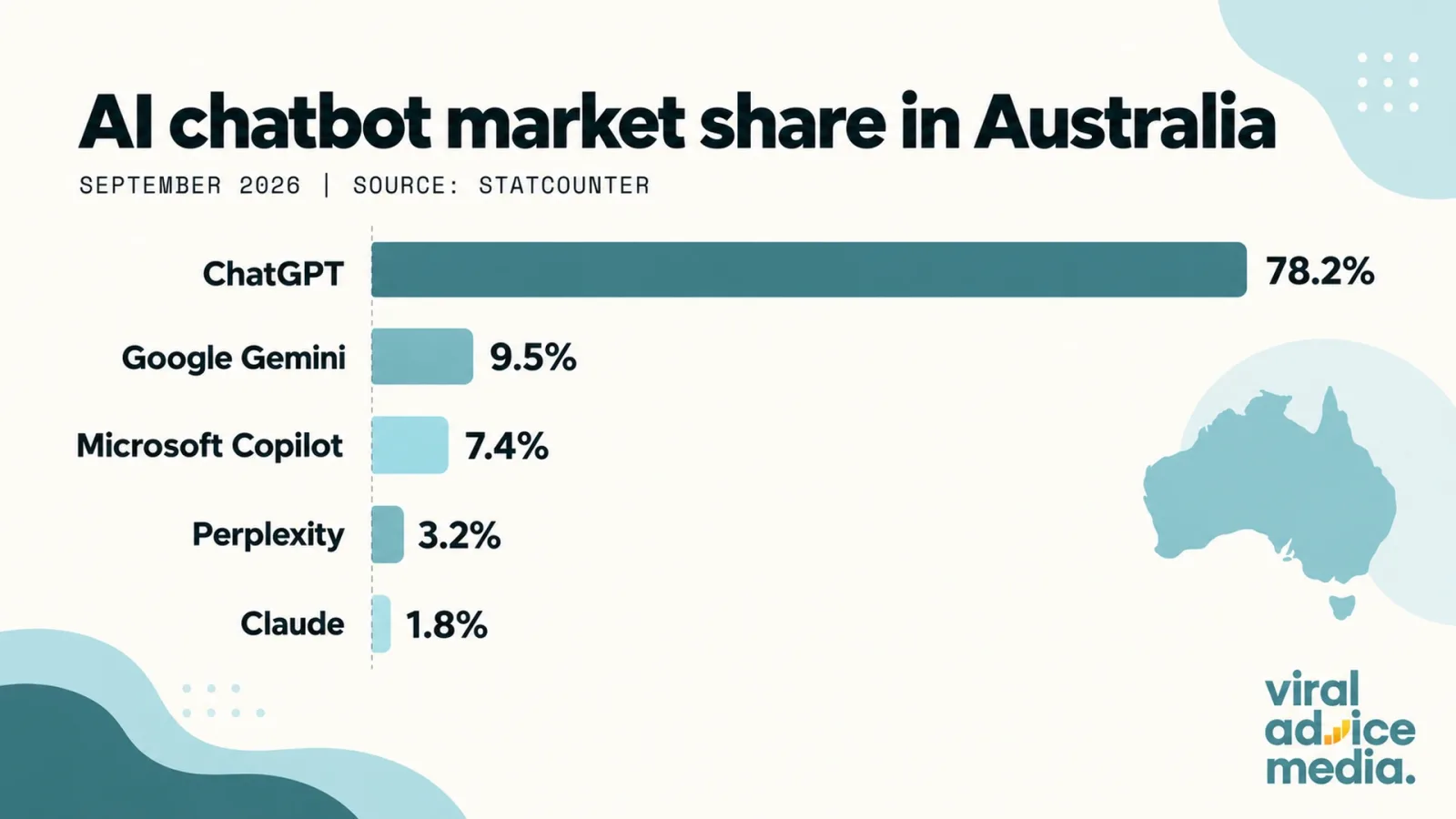
It is not only ChatGPT. According to Statcounter, Australia's AI chatbot market share in September 2026 looked like this:
| AI chatbot | Share in Australia (Sep 2026) | Where its answers come from |
|---|---|---|
| ChatGPT | 78.2% | Its own crawler plus third-party search results |
| Google Gemini | 9.5% | Google's index |
| Microsoft Copilot | 7.4% | Bing's index |
| Perplexity | 3.2% | Its own crawler and live web search |
| Claude | 1.8% | Its own crawler and web search |
Each platform reads the web in a slightly different way. That is why a business can look strong in one AI tool and be invisible in another.
There is a second shift to plan for. AI answers often solve the question on the spot, so fewer people click through to any website at all. The businesses that still win the enquiry are the ones named inside the answer. That makes being recommended, not just ranked, the new goal for Australian SEO.
Ranking on Google gets your book into the library. AI visibility is about being the book the librarian actually hands to the customer.
How do you check your AI visibility?
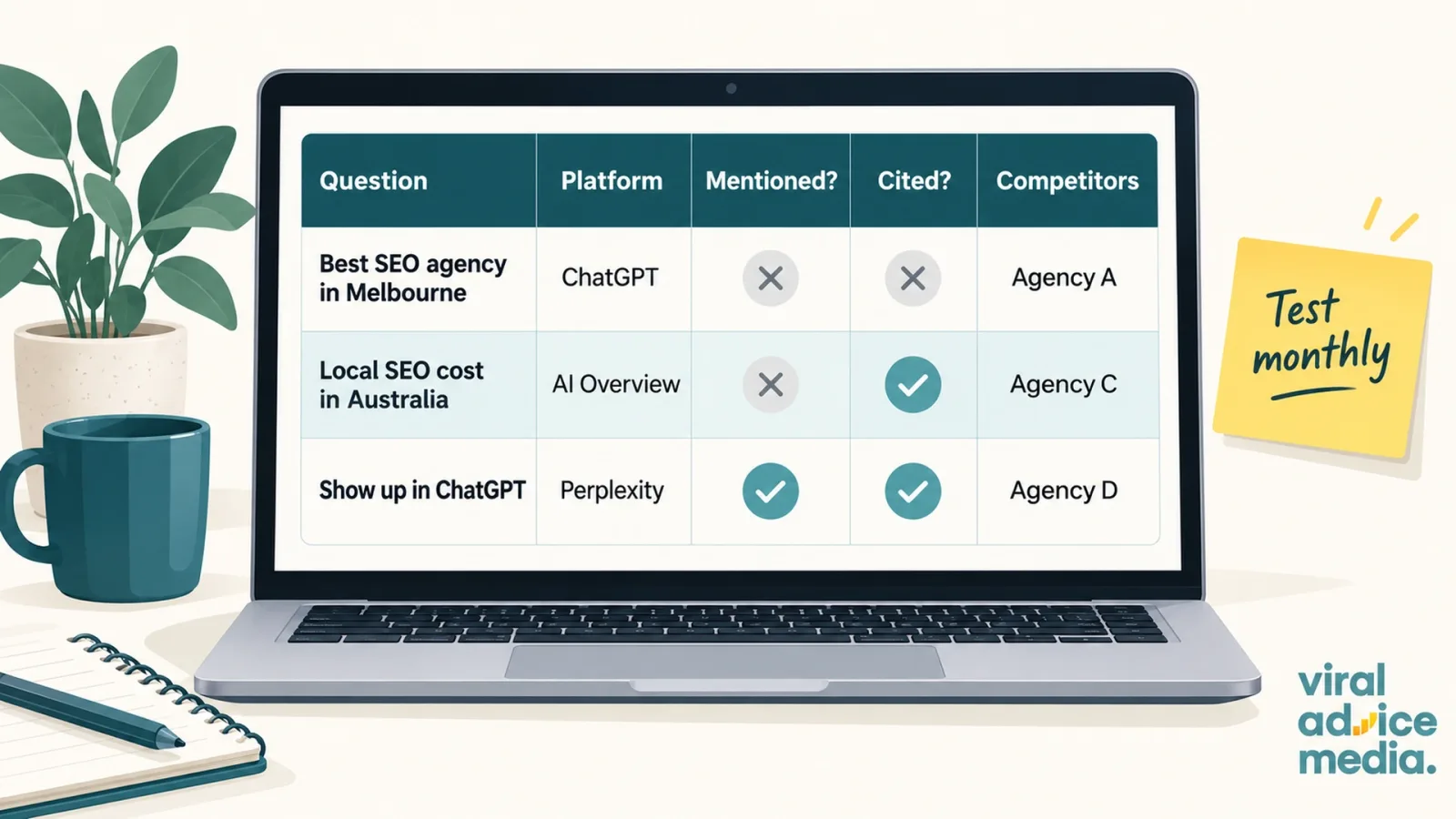
Write 15 to 20 questions your customers really ask, including your suburb or city. Ask each one in ChatGPT, Google AI Overviews and AI Mode, Gemini, Copilot and Perplexity. Record whether you are mentioned, whether your website is cited, which competitors appear, and anything said about you that is wrong.
- Use real customer wording. For example, "who does emergency electrical repairs in Penrith" or "best Shopify SEO agency in Australia". Your phone enquiries and Google Search Console queries are great sources.
- Test in a clean session. Log out or use a private window where you can, so your own history does not skew the answers.
- Log every answer. A simple spreadsheet is enough.
Not sure what to ask? Here are example questions for common Australian business types:
- Trades: "Who is a reliable emergency plumber in Parramatta?" or "Best licensed electrician on the Gold Coast"
- Health: "Bulk billing GP open on Saturday in Fitzroy" or "Best physio for back pain in Brisbane"
- Ecommerce: "Australian online store for sustainable activewear" or "Where to buy organic skincare made in Australia"
- Professional services: "Small business accountant in Perth who uses Xero" or "Family lawyer in Adelaide with fixed fees"
| Question | Platform | Mentioned? | Cited? | Competitors named |
|---|---|---|---|---|
| Best SEO agency in Melbourne for small business | ChatGPT | No | No | Agency A, Agency B |
| How much does local SEO cost in Australia | Google AI Overview | No | Yes | Agency C |
| Who can help my business show up in ChatGPT | Perplexity | Yes | Yes | Agency D |
Repeat the same set every month. AI answers change often, so the trend matters more than any single result.
Why do AI tools ignore your business, and how do you fix it?
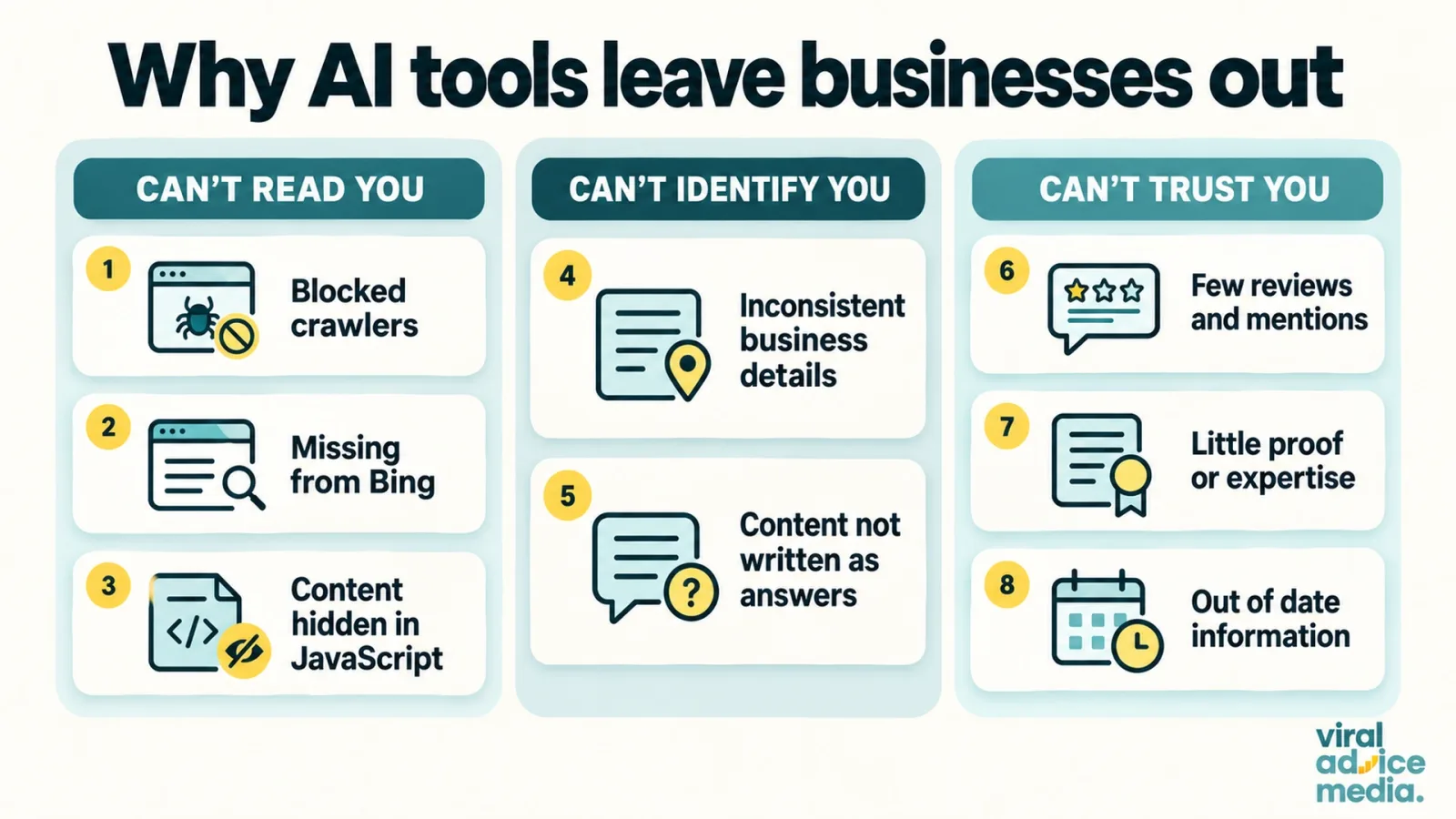
In most cases it comes down to eight causes. AI tools either cannot read your website, cannot tell who you are, or cannot find enough independent proof that you are a good choice. Each cause has a clear fix, and most take days rather than months.
1. You are blocking AI crawlers without realising it
AI platforms send their own crawlers to read websites. If your robots.txt file, firewall or hosting security blocks them, they cannot read or cite your pages. Some security and CDN tools block AI bots by default, so this catches many businesses out.
The fix: open yoursite.com.au/robots.txt and make sure it allows the search crawlers you want to be found by. These include OAI-SearchBot and ChatGPT-User for ChatGPT (see OpenAI's crawler guide), PerplexityBot (see Perplexity's crawler guide) and Bingbot for Copilot. Then check your CDN or security plugin for any "block AI bots" setting. You can still block training-only bots such as GPTBot while allowing the search bots that link to you.
A simple robots.txt setup that allows AI search bots but blocks OpenAI's training bot looks like this:
User-agent: OAI-SearchBot
Allow: /

User-agent: PerplexityBot
Allow: /

User-agent: Bingbot
Allow: /

User-agent: GPTBot
Disallow: /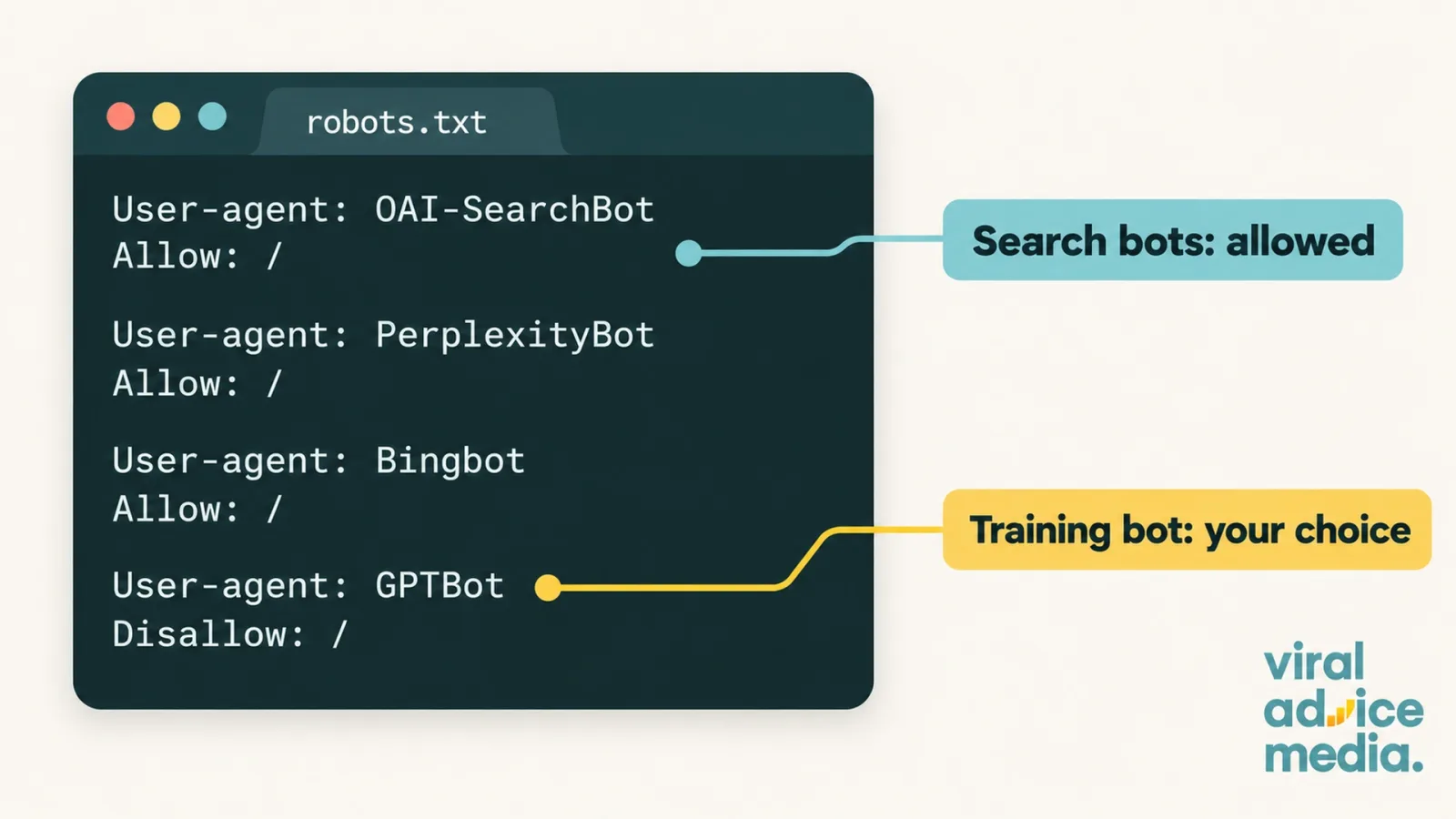
2. You are missing from Bing
Most Australian businesses only ever check Google Search Console. But Copilot answers from Bing, and Bing's index is used by other AI search tools too. If Bing has not indexed your key pages, you are cutting yourself out of a real share of AI answers.
The fix: verify your site in Bing Webmaster Tools. You can import it straight from Google Search Console. Submit your XML sitemap and switch on IndexNow so new and updated pages are picked up fast. Claim your Bing Places listing while you are there.
3. Your content is not written in answer-shaped passages
AI tools rarely cite whole pages. They pull short passages that answer one question cleanly. A service page full of slogans like "we are passionate about results" gives them nothing to quote.
The fix: use real customer questions as headings. Answer each one directly in the first two or three sentences underneath. Include details an AI can lift: price ranges in AUD, timeframes, the suburbs you service, what is included and who it suits. Add a short FAQ section to every key service page.
4. Your important content is hidden behind JavaScript
Google renders JavaScript well. Many AI crawlers do not. If your services, prices or reviews only appear after scripts run, tabs open or sliders move, AI tools may see an almost empty page.
The fix: make sure key content sits in the page HTML on first load. A quick test: view the page source (not the inspector) and search for a sentence from your services section. If you cannot find it, most AI crawlers cannot either.
5. AI tools are not sure who you are
AI systems think in entities: a business with a name, a location, a category and a reputation. If your name, address and description vary across your website, Google Business Profile, directories and social profiles, AI tools struggle to connect the dots. They will not risk recommending a business they cannot confidently identify.
The fix: use one consistent business name, address and phone number everywhere, matching the name registered against your ABN. Add Organization or LocalBusiness schema to your site with links to your official profiles. Write a clear About page that says who you are, where you work and what you specialise in.
6. Nobody else is talking about you
When AI tools build a recommendation, they look for agreement across the web: reviews, directory listings, "best of" articles, news coverage and forum discussions. A business that only talks about itself on its own website looks unproven.
The fix: build your footprint on the Australian sources AI tools read. Start with Google Business Profile, Apple Business Connect and Bing Places. Add relevant directories such as Yellow Pages, True Local, Hotfrog and ProductReview.com.au, plus hipages or Oneflare if you are in the trades. Ask happy customers for detailed reviews that mention the service and suburb. Pitch local media and industry associations for genuine mentions.
7. Your content lacks proof and expertise
AI systems favour sources that show real experience. Generic content that could describe any business, anywhere, is rarely cited.
The fix: add evidence only you have. That means named case studies with numbers, before and after results, original photos, your own pricing and real customer quotes. Put author names and credentials on your articles, and show licences and memberships where they apply.
8. Your information is out of date
AI search tools prefer fresh information, especially for prices, availability and "best of" questions. A service page last touched in 2022 is easy to pass over.
The fix: review your most important pages every quarter. Update prices, add new examples, show a "last updated" date and remove anything no longer true. Keep your Google Business Profile active with regular posts and current hours.
Quick reference: symptoms and fixes
| What you see | Likely cause | First fix |
|---|---|---|
| Never mentioned or cited on any platform | Crawlers blocked or pages not indexed | Check robots.txt, security settings and Bing indexing |
| Cited as a source but not recommended by name | Weak brand and entity signals | Consistent business details, schema and an About page |
| Competitors recommended instead of you | Few third-party mentions and reviews | Directories, reviews and local PR |
| AI gets your services or prices wrong | Outdated or unclear site content | Update key pages and add clear FAQs |
| Visible in ChatGPT but not in Copilot | Not indexed in Bing | Bing Webmaster Tools and IndexNow |
How can you improve AI visibility in 30 days?
Work in four weekly stages: audit, fix the technical foundations, rewrite your key pages around customer questions, then build outside mentions. The order matters. Better content is wasted if AI crawlers cannot reach your site or Bing has not indexed it.
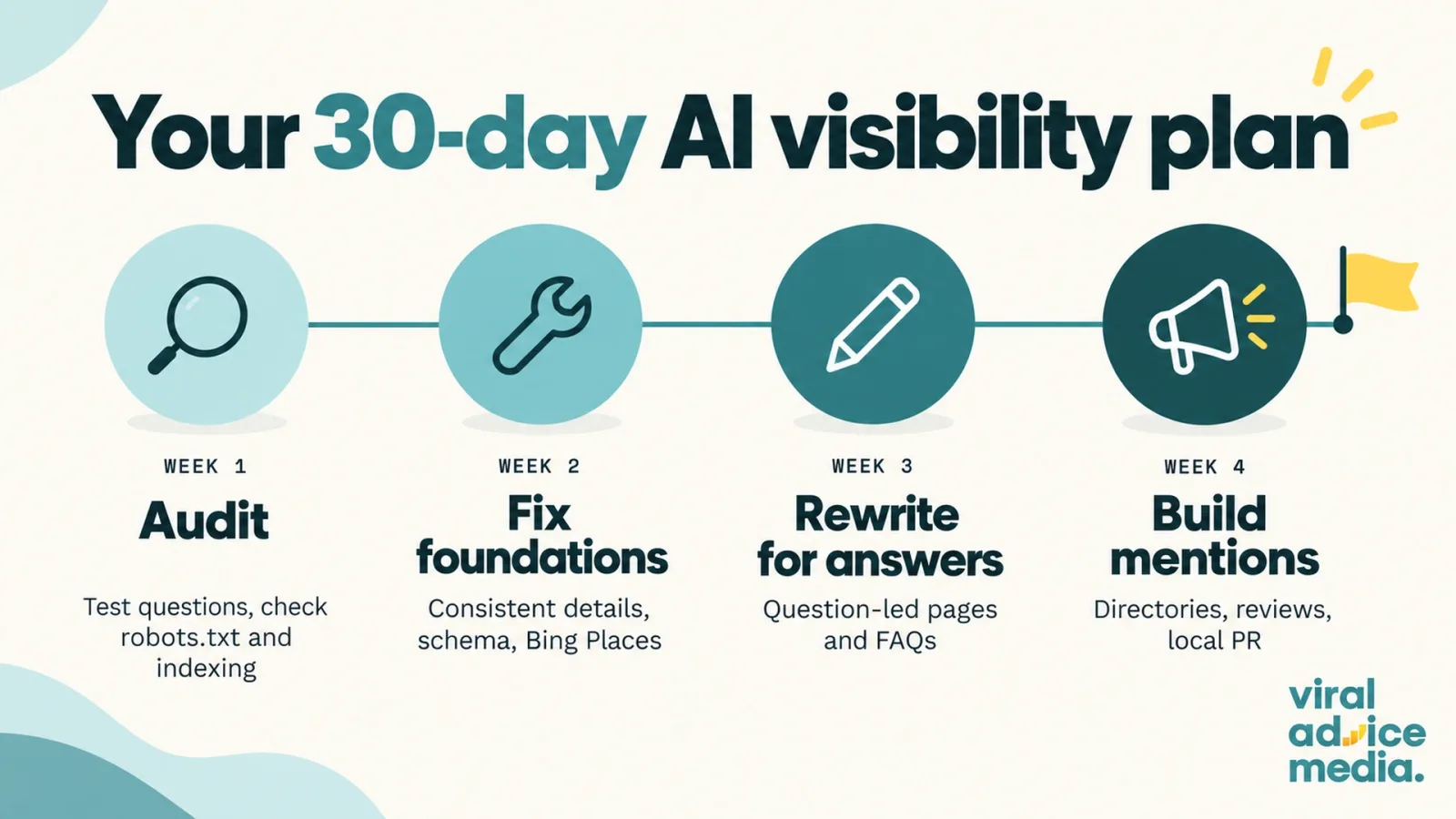
- Week 1, audit: run your question test, review robots.txt and security settings, and confirm your key pages are indexed in Google and Bing.
- Week 2, fix the foundations: make your business details consistent everywhere, add Organization or LocalBusiness schema, and claim Bing Places and Apple Business Connect.
- Week 3, rewrite for answers: rebuild your top five service pages around customer questions, add FAQs, and include pricing, timeframes and service areas.
- Week 4, build mentions: update directory listings, start a review drive and line up at least one genuine third-party mention.
Then run your question test again. Some platforms reflect changes within weeks, others take a few months, so keep testing monthly.
How do you measure AI visibility over time?
Combine three signals: your monthly question test, AI referral traffic in Google Analytics 4, and what new leads tell you. No single tool shows the full picture yet, because many people read an AI answer and then search your business name instead of clicking a link.
- AI referrals in GA4. Look for traffic from chatgpt.com, perplexity.ai, gemini.google.com and copilot.microsoft.com. Group them into a custom "AI search" channel so the trend is easy to spot.
- Branded searches. When AI tools recommend you, people often Google your name afterwards. Rising branded impressions in Search Console are a good sign.
- Ask new leads. Add "ChatGPT or another AI tool" to the "how did you hear about us" field on your enquiry form. Many AI-driven leads never show up as a referral in analytics.
Larger brands can use dedicated LLM tracking tools to monitor hundreds of prompts automatically. Our generative engine optimisation and AI SEO service includes this kind of tracking and reporting.
Where should you start? An expert tip from our team
Start with the two checks that take ten minutes: your robots.txt file and Bing Webmaster Tools. These are the first things we look at in every AI visibility audit, because one blocked crawler or a missing index can hide an otherwise strong website from several AI platforms at once.
Next, pick your single most valuable service page. Rewrite it around the five questions customers ask most often on the phone. Your front desk or sales team already knows them, and they are almost always the same questions people type into ChatGPT.
Finally, remember that AI visibility is built on local SEO. Your Google Business Profile, reviews and consistent listings feed AI answers as much as they feed the map pack. Businesses with solid local SEO in Sydney, Melbourne and Brisbane usually have a head start.
Common mistakes to avoid
- Blocking every bot "to be safe". A blanket block in a security plugin also blocks the AI search bots that would cite and link to you.
- Only checking ChatGPT. Gemini, Copilot and Google's own AI Overviews draw on different sources, so test them all.
- Publishing generic AI-written pages. AI tools rarely cite content that says nothing new. Add your own prices, examples and local detail.
- Buying or faking reviews. Fake reviews break Australian Consumer Law, and the ACCC can take action. Ask real customers instead.
Ready to get your business into the AI answer?
Low AI search visibility is rarely a mystery. AI tools skip businesses they cannot read, cannot identify or cannot verify. Fix access first, keep your details consistent across Australian directories, and rewrite key pages so they answer real questions clearly. Then test every month.
Viral Advice Media helps Australian businesses with SEO, AI search optimisation and ChatGPT optimisation. Book a free AI visibility check and we will show you which questions your competitors are winning, and what it will take to get you into the answer.